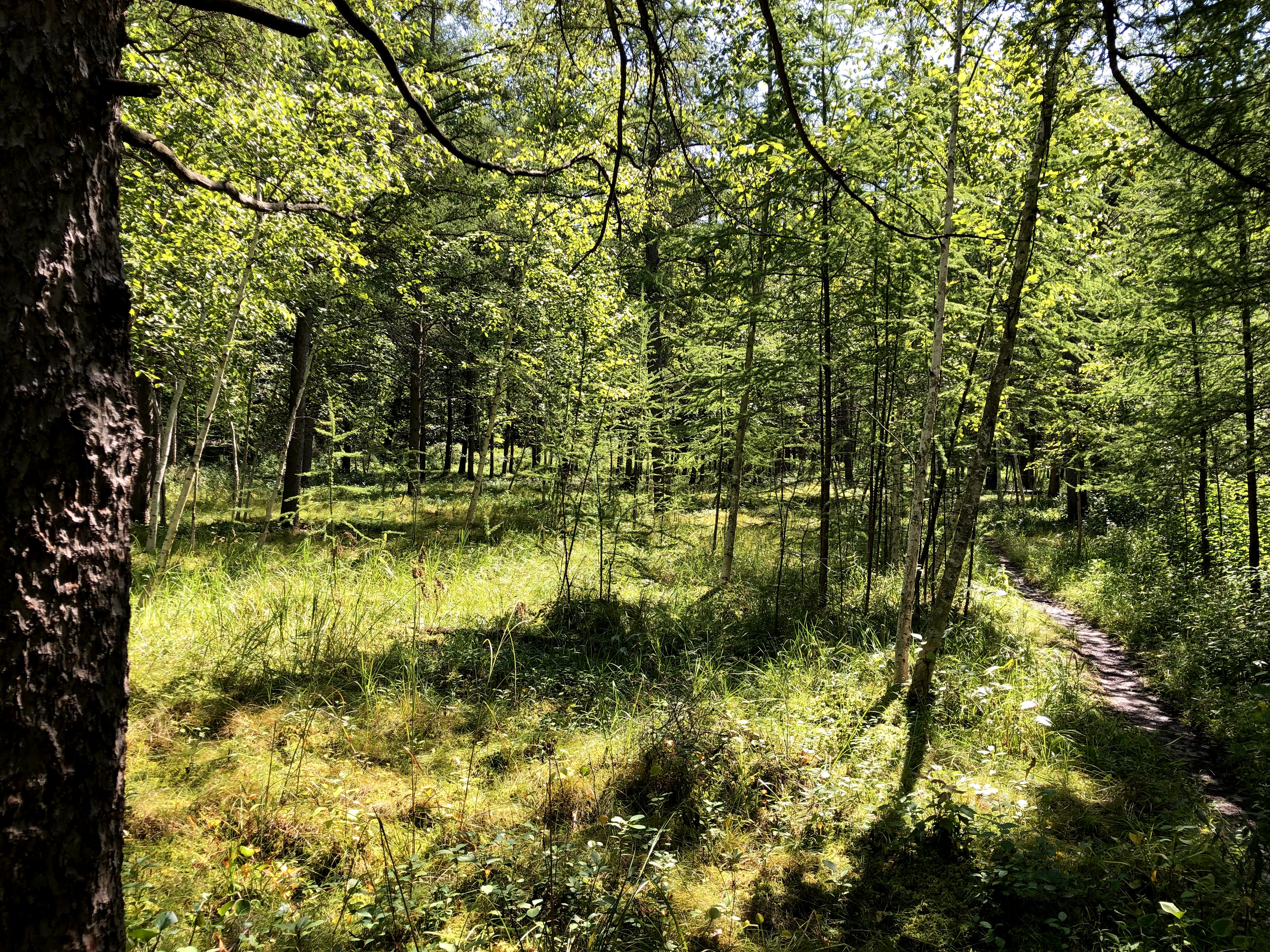
The Quaking Bog is a unique place in Minneapolis. At 3700 years old, it has an internal ecosystem that has escaped the influence of the city surrounding it. Kept on a boardwalk, each step forward is slightly squishy as the path sits upon sphagnum moss that is anchored in place by the tamarack trees. Yesterday was fairly rainy in the Twin Cities which made the boardwalk extra bouncy and the colors extra vibrant. I met a garter snake shortly after entering the bog, but her quick exit led me to believe there were more important things to attend to.
Since the area has been so dry for most of the summer, I found myself drawn to the prevalence of mushrooms that have seemingly flourished in the secluded marshy area. Two kinds were most heavily represented, with one having a more umbrella-shaped cap and the other flatter, with older specimens nearly convex. Focusing on the latter, a number of functions became apparent:
- the cap protects the gills
- the gills generate the spores needed for reproduction,
- the stem supports the mushroom’s structure while raising the gills high enough in the air to allow for a better chance of dispersal.
It’s hard to ignore the sphagnum moss that covers the “floor” of the tamarack bog like a carpet. In appearance, it’s nearly reminiscent of any number of the succulents I have killed with overwatering but its spongy feel suggests that it absorbs water and does so to survive. Taking in the thriving plants throughout the area, this water absorption likely benefits the bog, as well, by conserving water and keeping it near the ground, shielding it from the sun, and ensuring the moist conditions both the moss and tamarack trees prefer.
Because the moss appears so absorbent, I wonder what processes occur within the plant itself. I imagine that some sort of purification is occurring with the excess water such that it raises the question of if this demonstrated absorption property can be utilized in water conservation efforts.
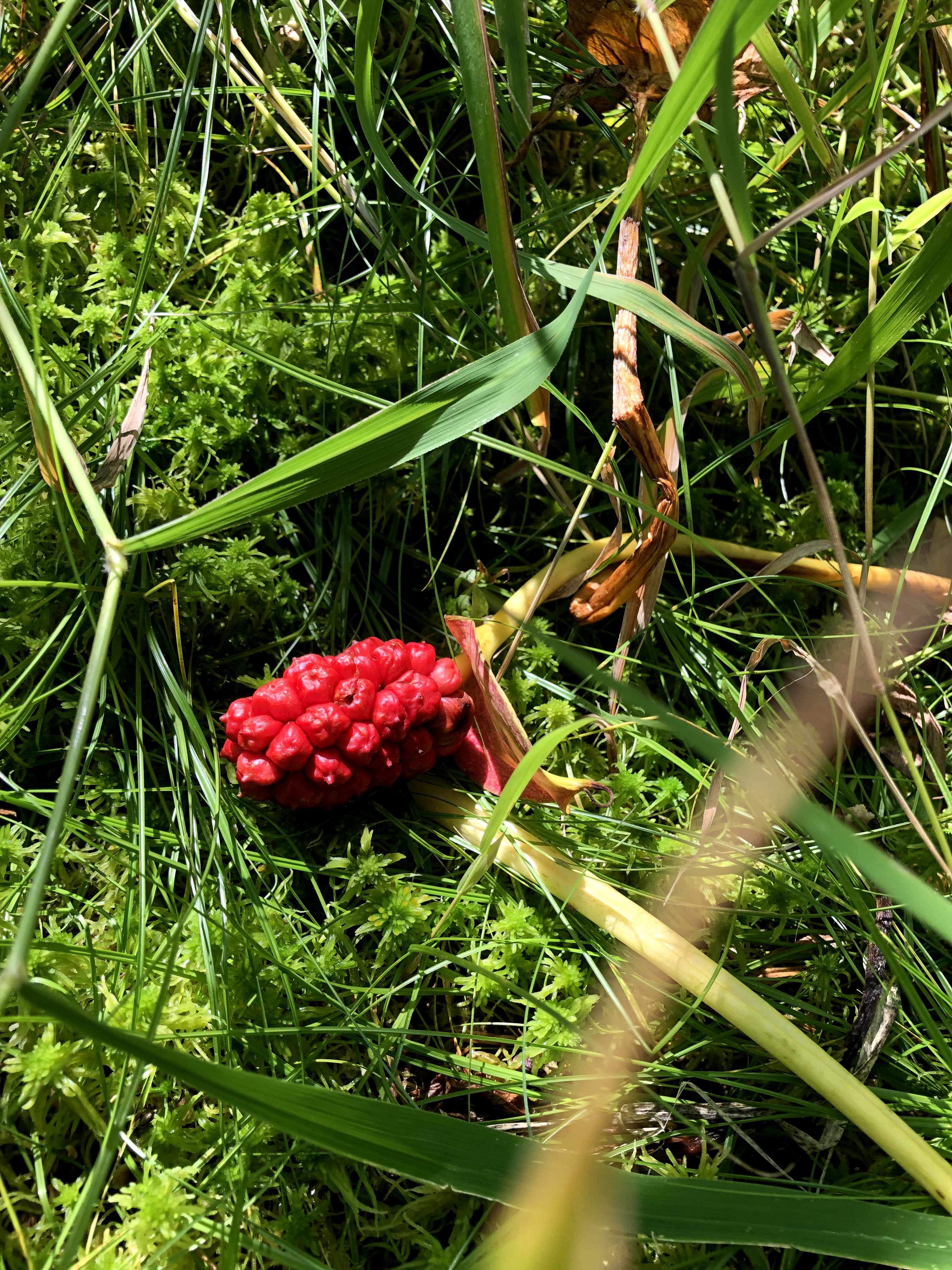
Certain spots held more water, and the sphagnum moss was absent. In these areas, wild calla grew in its place. From shallow, stagnant water grew stems with spade-shaped leaves that curled at the bottom. Per its environment, this shape seems to aid in water collection which benefits the plant and maintains the growing conditions it prefers. When backlit, the leaves’ veins appeared nearly translucent. The wild calla was in various states of reproduction throughout the bog, with some plants having green berries, others fully ripe red berries, and others no berries at all. Most of the berries I observed were no longer erect, leading me to think the seeds within weigh the stem down allowing for the seeds to germinate in the surrounding water.
The observed interaction between the organisms living within the Quaking Bog illustrates how it has survived for so long. Each species does what it needs to survive and also provides for the others around it. However, the bog is contained to just a small area within a much larger park; certain limits are inherently put in place within this boundary which allows for a predictable and controlled setting. When we put so much focus on expanding our boundaries and pushing the limits, the Quaking Bog presents a compelling argument for small-scale stability.
Location: Quaking Bog at Theodore Wirth Park
When: Noon
Conditions: Beautiful day, sunny, 70, slight breeze. The past few days were rainy so trails were somewhat muddy.
Focus/Intent: With the intent to observe functions, I went to the Quaking Bog, a tamarack bog in the middle of Minneapolis.


 Sarah J Morrison