Seal of Approval Jacket
About
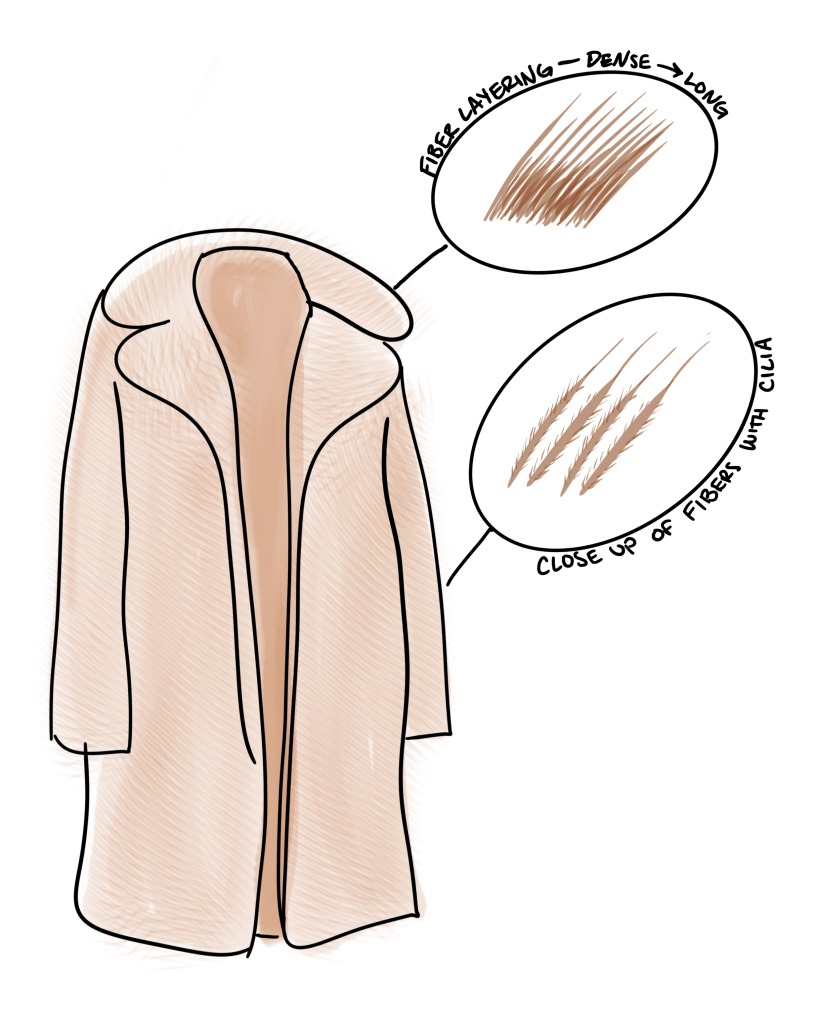
This Seal of Approval coat is fashion-forward and functional. Minnesota winters are notoriously physically and emotionally tasking. The skies are grey. The roads are white. Some people walk the streets in sleeping bags rebranded as outerwear. Others shiver in the name of fashion. With the Seal of Approval, wearers will get the weather protection they seek paired with a little extra flair. Inspired by the numbat’s piloerection, the insulative and protective two-layer fur systems of otters and seals, and the penguin’s waterproof and insulative feathers, the Seal of Approval layers fibers in such a way that protects from the elements while ensuring warmth. Where traditional faux fur is a statement and real fur is a non-starter, the Seal of Approval offers a functional and fashionable alternative.
Process
| Round 1 | Round 2 | Round 3 | |
| Identify | Create a new style of jacket that is adaptable to Minnesota winters. | Create a new style of jacket that is adaptable to Minnesota winters. | Create a new style of jacket that is adaptable to Minnesota winters. |
| Interpret | Functionally, this coat could: Retain warmth Keep out cold Generate heat Turn cold air warm | Functionally, this coat could: Retain warmth Keep cold air out Generate heat Protect from wind Protect from moisture | Functionally, this coat could: Retain warmth Keep cold air out Generate heat Protect from wind Protect from moisture |
| Discover | Numbats rely on absorbing heat from the sun to stay warm. They have sparse coats made up of shorter hairs that expose more skin to the sun to maximize absorption. Additionally, these shorter hairs stand up (piloerection) in cooler temperatures to shield the numbat from the cold by trapping body-heated air close to the skin, acting like a blanket. | Otters and seals have a two-layer fur system that creates one insulating layer and another that keeps water out. | Penguin feathers provide protection from both the water and the cold. Rather than utilizing layers, the feathers consist of two regions: the outermost protects from wind and water while the inner downy region retains warmth. Unlike other birds, these feathers lay in a uniform layer, rather than in tracts. |
| Abstract | Shorter hairs expose more skin in order to absorb heat. Shorter hairs stand up to restrict heat loss by trapping warm air. | Dense underhairs form an insulating layer, with 3+ underhairs growing out of each follicle. Longer guard hairs form a canopy over the underhairs to protect from moisture. | The upper parts of the feather overlap to protect from wind and water. The downy after-feather region contains barbs with cilia that connect with each other to form a uniform insulative layer. The feather shaft is attached to a muscle that pulls the feathers close to the body to form a water-tight barrier. |
| Emulate | A “hair coat” that is responsive to temperature changes. The coat absorbs heat from the sun and pushes towards the bottom layers of the coat. As the air turns colder, the hairs fluff out to prevent the heat from escaping. | The next “hair coat” iteration adds a second layer of hair. Due to the similar functions of the numbat hair and underhairs, this new layer will be made of longer fibers that prevent cold and moisture from reaching the lower layers that prevent heat from escaping. | Continuing with the idea of a protective outer layer and insulative inner layer, this iteration adds in the barbs and cilia to keep the fibers in a uniform pattern that reacts to outdoor conditions. When wet, the outer fibers pull inwards to prevent moisture from entering. When wind is present, the cilia interlock to force the fibers to move in unison so as to not expose the insulting bottom layer. |
| Evaluate | While this coat could meet the “evolve and adapt” principles, benign manufacturing does not seem likely. | Adding the second layer further optimizes the coat and makes it multi-functional. | While benign manufacturing still remains questionable, the interlocking fibers could be used for additional types of apparel or other outdoor gear. |
 Sarah J Morrison