Minneapolis had experienced a drought for a good portion of the summer leading to a very dead lawn in our backyard. With nothing to mow, my housemates and I ignored the ground cover for the better part of the summer. However, as the rain resumed and the temperatures dropped, we found that the yard was suddenly green again, but not with grass. Creeping charlie had lain down a blanket of leaves that was interrupted only by wandering morning glory vines that migrated away from the fence upon which they usually resided. The morning glories have climbed across the yard. There is evidence of their tendrils everywhere, from moving up the side of the house, to weaving around the bottom of the grill, to winding around the tallest plant until it reaches the top.
Taking in the rest of the yard and my slowing down garden, I noticed a number of organisms going to seed: dandelions with their fluffy seeds, parsley and its umbrella of small flowers, drying zinnia petals. The rose hips have ripened and are turning brown. The season is ending and the plants are preparing.
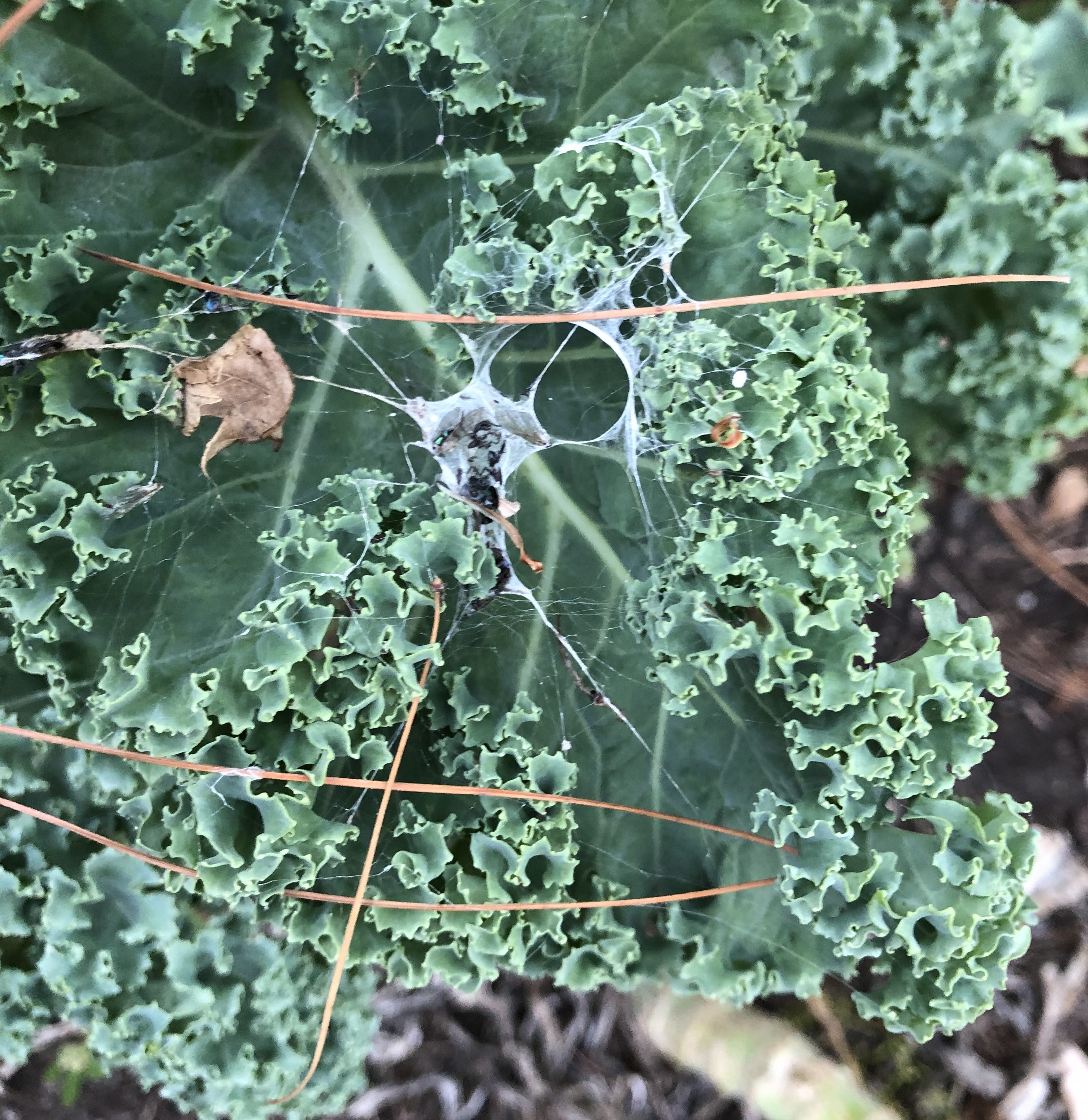
I checked in on the spider that has lived in my kale all summer and while she wasn’t home, a future meal remained, spun in webbing.
Some Observed Functions
- Morning glory tendrils attaching to the side of the house, spiraling up the stems of the sturdier plants, and weaving through lawn furniture.
- The spiraling tendrils are flexible and resistent to tension.
- The creeping charlie spreads via a stolon (or runner) which moves along the ground and lays roots and sprouts leaves at various nodes.
- Creeping charlie is resistent to many control methods because of these runners and an extensive root ball beneath the soil.
- Fluffy dandelion seeds are easily lifted and carried by the wind to new locations for reproduction.
- Zinnia petals dry on the plant. When dry, they fall carrying a seed attached at the bottom allowing them to easily reseed.
- Spider web used for capturing prey. At times, I’ve also observed the spider sitting beneath the webbing as protection from the elements.
Design
I have been fascinated for a few weeks now by the carpet of vines and creeping charlie that have made their way across our backyard to the point that I’m now considering letting them replace the entire ground cover. Both the morning glory tendrils and the creeping charlie runners are effective at spreading the plant as well as providing considerable structural support for each plant. These climbing and reaching abilities also seem to contribute handily to their respective plants’ resiliency. My first thought is that these spiraling, climbing, reaching, and hardy characteristics could be applied to robotics, but I wouldn’t be surprised if vines (maybe not creeping charlie) have already been considered as inspiration in that realm.
The creeping charlie’s seemingly effortless survival due to its runners and root system seems particularly apt for design. It’s a regenerative organism that, even when entire sections are removed, will simply return. I’m not saying it’s an ethical idea, but it feels like creeping charlie would be an effective model for corporate espionage. Alternately, this idea of nodes with offshoots anchored to a resilient root system could be applied to community organizing growing to citywide organizing to statewide organizing and beyond. The problem with a lot of movements is that setbacks can often stop a movement before it even begins. But if there’s one thing I know about creeping charlie, it’s that once you cut it back, it returns even stronger.
Location: My backyard
When: Dusk
Conditions: A little warm, no breeze but can feel the cold evening air moving in.



 Sarah J Morrison